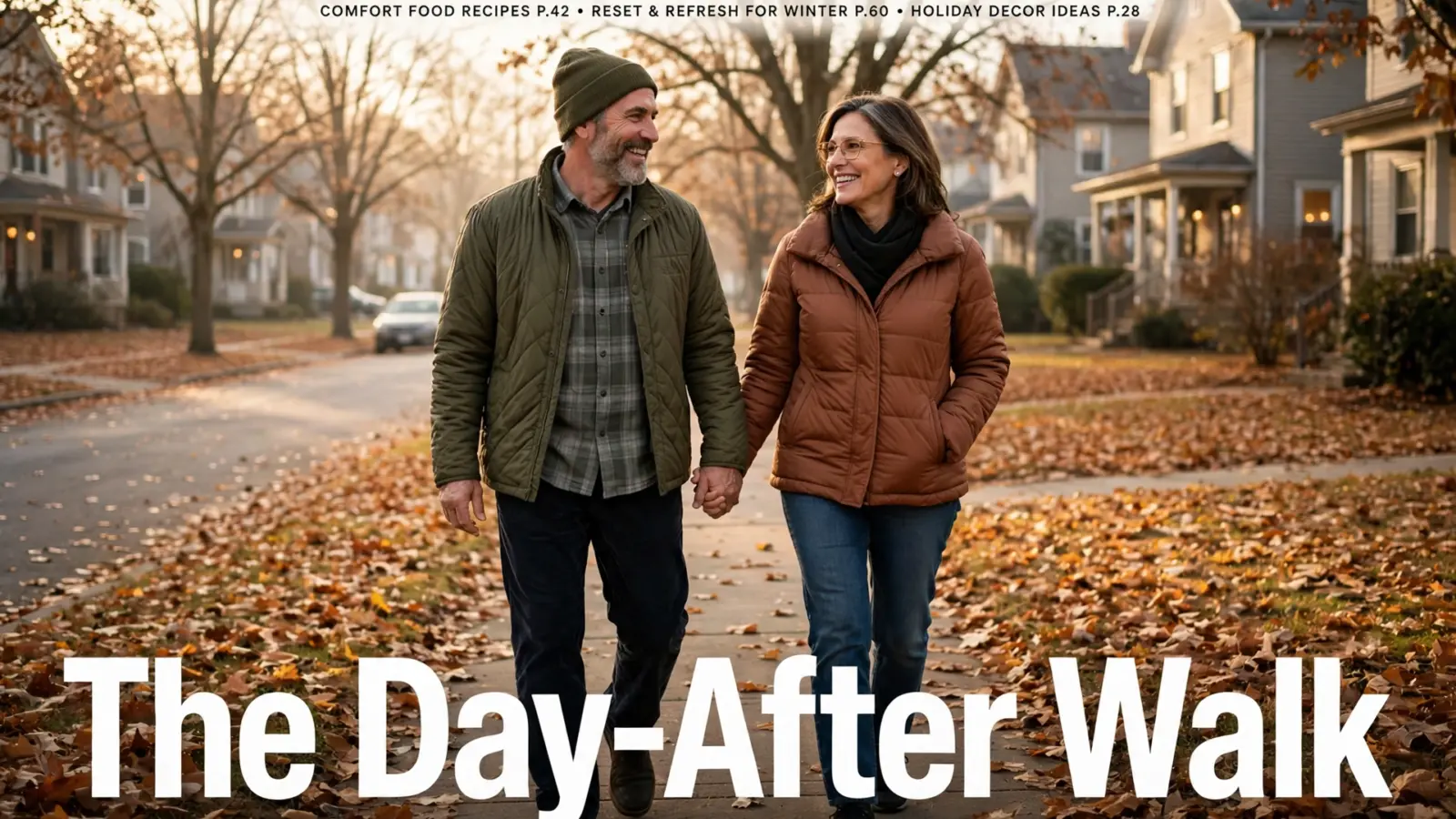
The Day-After Walk: Why a 20-Minute Walk Beats a Punishment Workout
The morning after Thanksgiving has its own soundtrack: the refrigerator door opening and closing, a leftover pie tin being quietly investigated, and somebody — maybe you — announcing that today calls for a serious workout to “make up for yesterday.”
Here is a kinder, smarter idea. Skip the punishment workout. Put on comfortable shoes, step outside, and take a 20-minute walk.
That may sound too easy to count. After 50, easy is often exactly the point. A gentle walk does real work for your blood sugar, joints, digestion, and mood — and unlike the heroic workout you dread and then skip, you will actually do it again tomorrow.
The Problem With Punishment Workouts
A punishment workout starts from a shaky idea: that one big meal damaged you, and now you have to pay for it.
It is not how your body works. One holiday meal is one day. Your health is built — or worn down — by what you do most days, not by what happened between the turkey and the pie on a Thursday in November.
Punishment also backfires. A hard workout after a day of eating, sitting, and sleeping poorly is a recipe for sore knees, a cranky back, and a quiet decision that exercise is miserable — shelved until January, when it returns as a resolution.
- Guilt is a poor coach. It shouts for one day and then disappears.
- Soreness is a poor reward. It makes the next session less likely, not more.
- All-or-nothing plans break on the first busy, rainy, or tired day.
A walk asks for none of that. It is not payment for yesterday. It is simply the next normal, healthy thing.
You do not need to earn back a holiday. You just need a next step — and a walk is a very good one.
What a Post-Meal Walk Actually Does
When you eat, your blood sugar rises as your body breaks food down. When you walk soon after, your leg muscles go to work — and working muscles use glucose for fuel. That gentle demand helps blunt the rise and fall that can leave you sluggish and craving another slice an hour later.
Both the American Diabetes Association and the American Heart Association encourage regular, everyday movement for blood sugar and heart health — and walking is the form they return to again and again, because people keep doing it.
A day-after walk also helps in quieter ways:
- Digestion feels lighter. Gentle movement supports digestion, so the “still full at noon” feeling tends to ease sooner.
- Stiffness loosens up. Hours in a dining chair, a car, or a couch leave hips, knees, and lower backs tight. Walking is a mild, rhythmic way to oil the joints again.
- Mood lifts. Daylight and fresh air do what another cup of coffee cannot — especially after a loud, lovely, tiring holiday.
- Sleep improves that night. A daytime walk outdoors helps reset your body clock after a day when meals and bedtime drifted late.
None of this requires intensity. Moderate effort works better than hard effort, which competes with digestion and leaves most of us feeling worse.
Why 20 Minutes Is the Sweet Spot After 50
Twenty minutes is long enough to matter and short enough to be unarguable. No change of clothes, no drive, no blocked-off afternoon. It fits between leftovers lunch and a phone call with family — and that fit is the whole secret.
After 50, the math changes in your favor when you choose consistency over intensity:
- Joints prefer rhythm to impact. Walking loads knees, hips, and ankles in a steady, predictable pattern — no jumping, no sudden twisting, no heavy weight to manage while your body is still in holiday mode.
- Balance gets practice. Every step is a small balance exercise, helping you stay steady on curbs, stairs, and uneven ground.
- Recovery is built in. A 20-minute walk leaves you pleasantly tired, not wiped out, so you can repeat it tomorrow — which is where the benefits live.
- It stacks with ordinary life. Walk to get the mail the long way, walk while a grandchild rides a bike beside you, walk the dog an extra block. It all counts.
Five gentle walks a week will do more for you by Christmas than one heroic workout followed by three weeks of avoiding the gym.
How to Do the Day-After Walk Well
- Time it loosely. Heading out within an hour or so after a meal is a good window for the blood-sugar benefit. Today, simply pick your biggest leftover meal and walk after that one.
- Use the talk test. Walk at a pace where you can hold a conversation in full sentences, with just a little extra breath. If you are gasping, slow down. If you could sing, pick it up slightly.
- Dress for comfort, not performance. Supportive shoes, a layer you can tie around your waist, gloves if the morning is cold. Comfort gets you out the door again tomorrow.
- Choose a friendly route. A flat loop you know well beats an ambitious hill route today. Save the hills for next week.
- Bring company if you can. A spouse, a neighbor, a visiting adult child, a dog — company turns a health habit into the best conversation of the weekend.
- End while it still feels good. Finish wanting a little more. That wanting is what brings you back.
If 20 minutes feels like too much today, take 10. A shorter walk done beats a longer walk postponed. If 20 feels easy, enjoy it — just resist turning it into a test.
Turn One Walk Into a Weekend Rhythm
The real prize is not Friday’s walk. It is the rhythm it can start.
- Friday: The day-after walk itself — 20 minutes after your biggest meal, easy pace, no agenda beyond fresh air.
- Saturday: Repeat it, and add one tiny extra: a few gentle sit-to-stands from a sturdy chair, or a minute of standing balance practice holding a counter.
- Sunday: Walk a slightly different route, ideally with someone. Notice how much more normal your energy feels compared with Friday morning.
By Monday, you have not “started a program.” You have simply walked three days in a row — which, quietly, is a program, and a sustainable one.
For more plain-language guides, browse Health Captain.
When to Skip the Walk and Check In Instead
A gentle walk suits most people, most days, but listen to your body first. Skip it and check in with your doctor or an urgent care line instead if you notice:
- Chest pain, pressure, or unusual shortness of breath
- Dizziness, faintness, or a feeling that the room is moving
- Sharp joint pain, a fresh injury, or new swelling
- Numbness, weakness, or trouble speaking — treat these as urgent, always
If you take medication that affects blood sugar, notice how you feel during and after your first few post-meal walks, and mention the new habit at your next appointment.
A Stronger Base for All That Walking
Walking is the foundation — and foundations deserve support. As the walks add up, simple strength and balance work makes everything feel easier: getting up from low chairs, carrying groceries, catching yourself on an uneven sidewalk.
That is exactly what Strong After 50: Muscle, Bone & Balance was built for — a joint-friendly guide to building muscle, supporting your bones, and improving balance at home, at your own pace. It is $29, and it pairs with a daily walk the way a good railing pairs with a staircase.
Get Strong After 50: Muscle, Bone & Balance on Gumroad — $29
The Bottom Line
Thanksgiving was a meal, not a mistake. You do not need to punish yourself for it, or a heroic workout to be “back on track.” There is no track. There is just today, a pair of comfortable shoes, and 20 minutes.
Take the walk. Enjoy the cold air and the quiet streets. Then do it again tomorrow — because after 50, the workout that wins is never the hardest one. It is the one you keep doing.