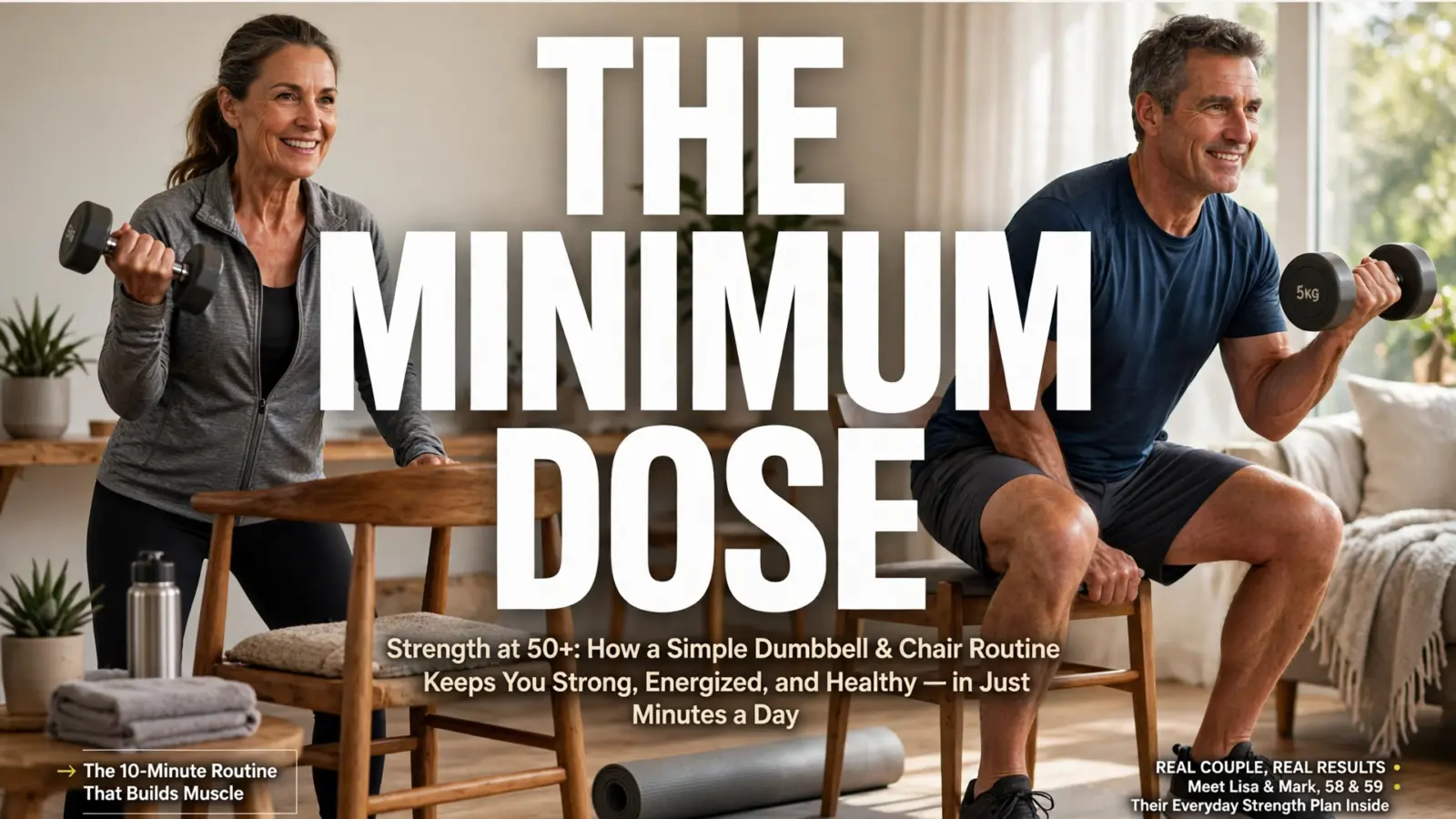
Strength After 50: The Minimum Dose That Actually Works
Most people over 50 who don’t lift anything heavier than a grocery bag share the same worry: they know they should do some strength training, but the versions they see — hour-long gym sessions, complicated programs, twenty-something instructors shouting about max effort — feel built for somebody else’s life.
Here is the encouraging truth the research keeps pointing to: you do not need the maximum dose. You need the minimum dose that actually works, repeated consistently. For most adults over 50, that dose is surprisingly small: two short sessions a week, a handful of basic movements, enough protein, and real rest in between.
This is a look at what that minimum dose is, why it works, and how to start it safely.
Why Muscle Is Worth Protecting After 50
Starting somewhere in our 40s and 50s, adults gradually lose muscle mass and strength — a process researchers call sarcopenia. Left alone, it can amount to a few percent of muscle per year, and it shows up in ordinary life long before it shows up in a mirror:
- Getting up from a low chair takes a push from the arms
- Stairs feel steeper than they used to
- A stumble becomes harder to catch
- Grocery bags, suitcases, and grandkids all feel heavier
Muscle is also working tissue, not just moving tissue. It helps your body handle blood sugar, supports your joints, and loads your bones in a way that encourages them to stay strong. Fitness pioneer Jack LaLanne, who exercised daily into his nineties, put the philosophy simply:
“Exercise is king. Nutrition is queen. Put them together and you’ve got a kingdom.” — Jack LaLanne
The good news hidden in the sarcopenia research is that muscle after 50 still responds to training. It responds more slowly than it did at 25, but it responds — at almost any age, and starting from almost any level.
The Minimum Dose: What “Enough” Actually Looks Like
The CDC’s physical activity guidelines for older adults call for muscle-strengthening activities on two days a week, working all the major muscle groups. The American Heart Association echoes the same twice-weekly target, alongside balance work for fall prevention.
Translated into a real week, the minimum effective dose looks like this:
- Two sessions per week, on non-consecutive days — Monday and Thursday, say
- 20 to 30 minutes per session — not an hour
- Five basic movement patterns, one or two sets each
- Moderate effort — the last couple of repetitions feel challenging but controlled, never sloppy
- At least one full rest day between sessions for the same muscles
That is it. Two half-hours. Studies of older adults consistently find that this level of training improves strength, chair-rise ability, and balance — the exact capacities daily life depends on. More can add more, eventually. But the minimum is where the biggest return lives, because it is the dose people actually keep doing.
You do not need the maximum you can survive. You need the minimum you will actually repeat.
The Five Movements That Cover Almost Everything
You do not need a gym full of machines. Five movement patterns train nearly every major muscle group, and each has a joint-friendly, at-home version:
- Sit-to-stand (the squat pattern). Sit on a sturdy chair, stand up, sit back down with control. This single movement rebuilds the exact strength you use for chairs, toilets, and car seats all day. Hold light weights as it gets easier.
- The hinge. Practice pushing your hips back — like closing a car door with your backside — with a flat back. It strengthens the glutes, hamstrings, and lower back that protect you when you lift anything off the floor.
- The push. Wall push-ups, countertop push-ups, or floor push-ups. Chest, shoulders, and arms for pushing doors, getting up off the floor, and catching yourself.
- The pull. A resistance band anchored to a door, rowed toward your ribs. The upper-back muscles that hold your posture upright live here.
- The loaded carry. Pick up something moderately heavy in each hand — dumbbells, water jugs, loaded grocery bags — and walk tall for 30 to 60 seconds. Grip, shoulders, core, and balance, all in one deceptively simple package.
One or two sets of 8 to 12 controlled repetitions for the first four, two or three carries, and you have a complete session. When the last reps of a set start feeling easy for two sessions in a row, add a little weight or slow the movement down. That gentle progression is what tells muscle to keep adapting.
Protein: The Other Half of the Dose
Training is the signal; protein is the building material. Without enough of it, the minimum dose underdelivers — and many adults over 50 quietly under-eat protein, especially at breakfast.
Practical basics, without turning eating into arithmetic:
- Anchor every meal with a protein food — eggs, Greek yogurt, cottage cheese, fish, chicken, beans, or lentils
- Aim for a palm-sized portion at lunch and dinner, and something protein-based at breakfast instead of toast alone
- Spread it across the day rather than saving it all for dinner — older muscles respond better to protein at each meal
- Have your protein-and-produce meal within a few hours after training, as part of normal eating, not as a special supplement ritual
Many clinicians who work with older adults suggest roughly 1.0 to 1.2 grams of protein per kilogram of body weight per day as a working target for active people — worth confirming with your own doctor or dietitian, especially if you have kidney concerns or other conditions that change the advice.
Recovery Is Part of the Prescription
After 50, adaptation happens between sessions, not during them — and it happens a little more slowly than it used to. That is not a flaw; it is the schedule.
- Rest at least 48 hours before training the same muscles again — the two-session week builds this in automatically
- Expect mild soreness in week one, the dull, “I did something” kind. Sharp or joint-specific pain is different — that is information to back off and, if it persists, to get checked
- Sleep is when the repair crew works. Protecting your normal bedtime does more for strength gains than any powder
- Easy days are not off days. Walking, gardening, and stretching between sessions keep joints happy and blood moving
A Word on Starting Safely
This article is education, not medical advice, and the minimum dose still deserves a sensible on-ramp. Check in with your doctor first if you have uncontrolled blood pressure, a heart condition, recent surgery, significant joint problems, or osteoporosis — and stop and get checked for chest pain, dizziness, or unusual breathlessness during any session. Start every movement at the easiest version. A chair-height sit-to-stand with no weight is a legitimate, effective first session.
For more plain-language guides to staying capable after 50, browse Health Captain.
The Guide That Puts It All Together
If you like the minimum-dose idea but want it laid out as a complete plan — the movements with progressions, balance drills, bone-supporting work, and a 30-day journal to keep you honest — that is exactly what Strong After 50: Muscle, Bone & Balance was built to be. It is a practical guide and workbook designed for real homes and real joints, at your own pace.
It is normally $29, but through Monday, November 30, 2026 at 11:59 PM ET, code BLKFRIDAY7 takes 40% off on Gumroad, bringing it to $17.40.
Get Strong After 50: Muscle, Bone & Balance on Gumroad — $17.40 with BLKFRIDAY7
The Bottom Line
Strength after 50 is not an athlete’s project. It is maintenance on the only body you will ever live in — and the maintenance dose is smaller than you feared: two short sessions a week, five honest movements, protein at every meal, and rest treated as part of the program. Start with one chair, one set, and this week. The minimum dose, repeated, beats the perfect program you never begin.