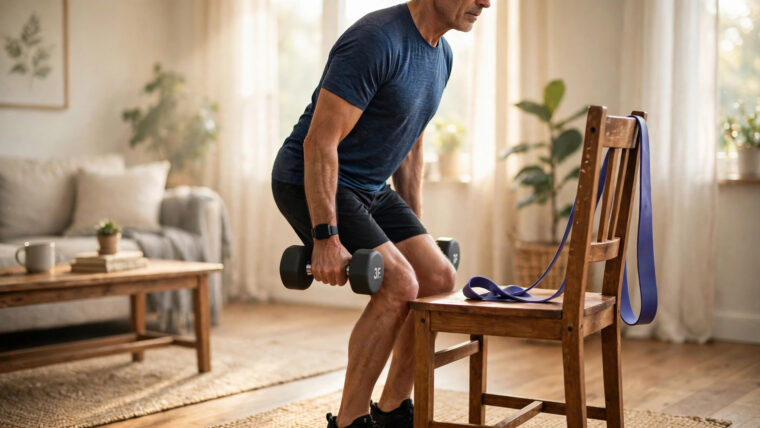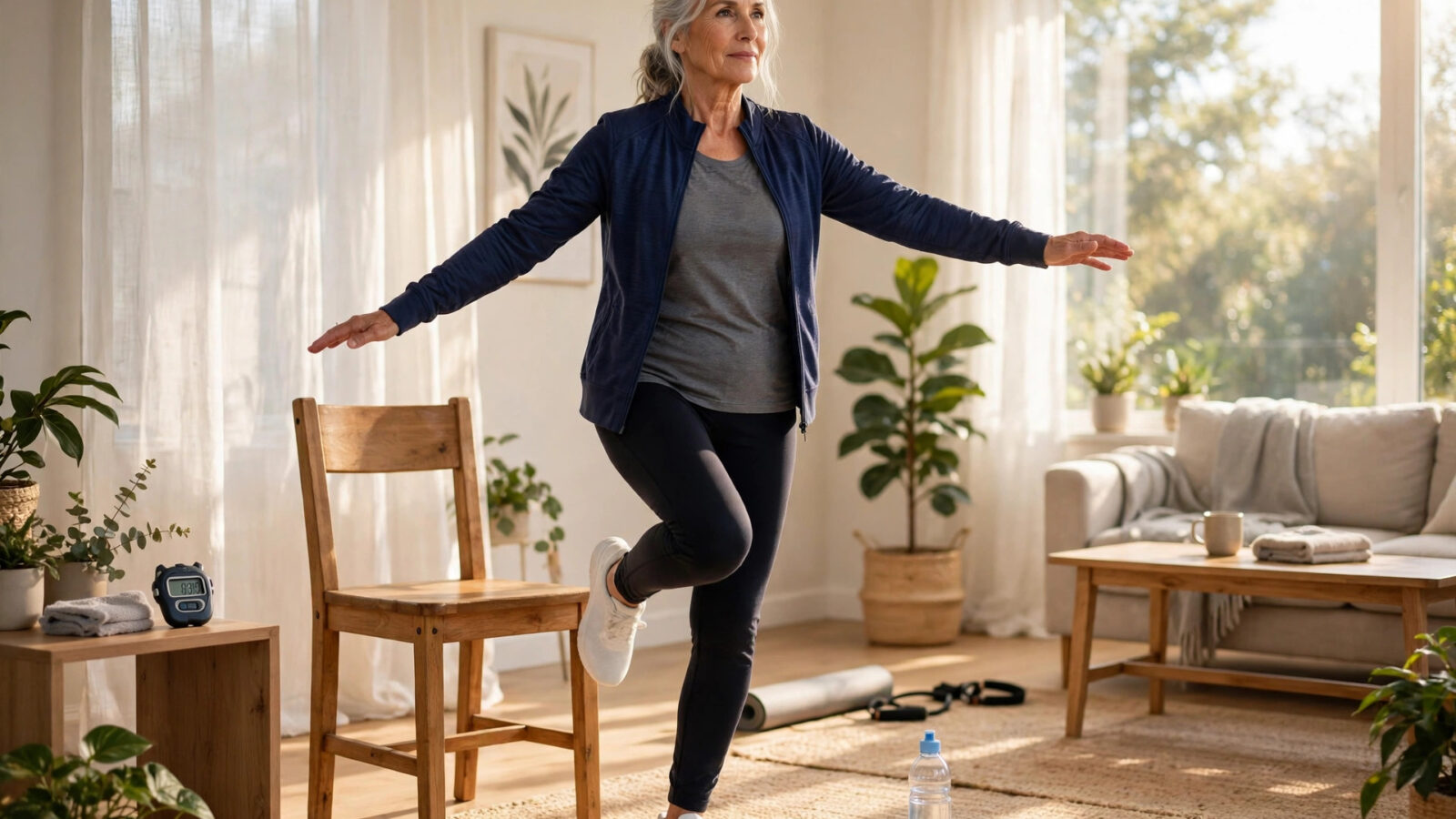
You need a chair, eight feet of floor, and a stopwatch. That’s the longevity test.
In a study of 13,423 adults aged 65 and older, published August 10, 2026 in JAMA Network Open and reported by Harvard Health on November 3, the people with the highest combined fitness scores had a 61% lower risk of dying over seven years than the people with the lowest scores. And of all the fitness qualities measured, the one most strongly linked with survival wasn’t cardio. It was balance and agility.
Not strength. Not endurance. The ability to stand on one leg, and to get out of a chair, walk eight feet around a marker, and sit back down.
Before you cancel your walking routine, read the fine print — because the 61% doesn’t mean what the headline wants it to mean. But the finding underneath it is real, and the test is one you can do in your living room tonight.
What the study actually did
Researchers in Taiwan tested 13,423 community-dwelling adults aged 65 and older — mean age about 73, nearly two-thirds women — during 2015 and 2016. Then they followed them for seven years. During that time, 1,631 of them died.
Each person took six simple fitness tests:
- Cardio: a two-minute march in place.
- Strength: a 30-second arm curl, and a 30-second chair stand — how many times you can rise from a chair in half a minute.
- Balance: a one-leg stand.
- Agility: an eight-foot up-and-go — sit in a chair, stand, walk eight feet around a cone, walk back, sit down, timed.
- Flexibility: two reach tests.
Then the researchers combined the cardio, strength, and balance/agility scores into one composite and compared the people at the top with the people at the bottom. The top group had a 61% lower risk of death over the seven years.
Looked at one test at a time, balance and agility showed the strongest links with survival. Lower-body strength — the chair stands — came next, then the two-minute march. Flexibility showed no link with lifespan at all.
One detail sharpens the picture. On the eight-foot up-and-go alone, the fastest fifth of participants had a 59% lower adjusted risk of dying than the slowest fifth. A chair, a cone, and eight feet of floor — and that little drill was the single test most strongly tied to who was still alive seven years later.
Why balance punches above its weight
Balance looks like one skill. It isn’t. It’s a whole committee working at once: leg strength to hold you up, nerves in your feet telling your brain where the floor is, eyes and inner ear keeping you oriented, and reflexes fast enough to catch a wobble before it becomes a fall.
That’s probably why it shows up so strongly in a study like this. A one-leg stand doesn’t just measure your ankles. It measures whether all those systems are still talking to each other. When they stop cooperating, the first thing that goes is usually steadiness — and the thing that follows is often a fall. Falls are one of the biggest threats to independence after 65, and they rarely come out of nowhere. The wobble comes first.
Cardio still matters — nobody in this study is saying otherwise. The 61% figure belongs to the combined score: cardio plus strength plus balance and agility together. The people who did best did well across the board. Balance didn’t beat cardio by replacing it. It beat cardio in the individual rankings while the big number came from having all three.
Harvard’s own summary says it plainly, and it’s worth quoting: no single fitness type stood out as the most important for longevity. Balance and agility appeared comparably important to cardiovascular fitness and muscle strength. The headline writes itself as “balance wins.” The study says something quieter and more useful: balance belongs beside cardio and strength, not behind them.
The living-room tests
Three of the study’s tests translate directly to a living room. Try them with a sturdy chair nearby and a wall or countertop within reach. If you already feel unsteady, have a history of falls, or have heart or blood-pressure issues, talk to your doctor first — and do these with someone else in the room.
1. The one-leg stand. Stand near a wall or counter, feet together. Lift one foot a few inches off the floor and hold. Time how long you can stand before you wobble, grab, or put the foot down. Switch sides. There is no pass mark to chase here — the point is to learn where you are, and to notice whether one side is much worse than the other.
2. The eight-foot up-and-go. Put a chair on a clear stretch of floor and mark a spot eight feet in front of it — a water bottle works. Sit in the chair, hands in your lap. On “go,” stand up, walk to the marker, walk around it, walk back, and sit down. Time the whole thing. Go at a comfortable, brisk pace, not a sprint. If you need the chair arms to get up, use them — and note that you did.
3. The chair stand. Sit in the same chair, arms crossed over your chest. In 30 seconds, stand up fully and sit back down as many times as you can, without using your hands. Count the completed stands. This one doubles as strength and balance — the same lower-body strength that ranked second in the study.
Write the numbers down with the date. Repeat monthly. The trend is the test: holding steady is good news, and a slow decline is worth mentioning to your doctor before it becomes a stumble.
How to train it
Balance responds to small, frequent practice better than to heroic workouts. A few things that fit into an ordinary day:
- Single-leg stands while you wait. Brush your teeth standing on one leg, hand hovering near the counter. Wash dishes the same way. Thirty seconds a side, once or twice a day.
- Heel-to-toe walking. Walk a straight line along a wall, placing the heel of one foot directly in front of the toes of the other, like walking a tightrope. Arms out if you need them.
- Sit-to-stand practice. Ten slow chair stands, once a day, no hands if you can manage it. This is the study’s own strength test, turned into training.
- Tai chi. If you want a structured option, tai chi is one of the most-studied balance practices there is, and classes for older adults are everywhere. It trains exactly the combination the study measured: balance, agility, and leg strength, at a pace that doesn’t punish a beginner.
None of this replaces walking or strength work. It sits next to them — which is the study’s real message. The people who lived longest weren’t the best at one thing. They were good at several things at once.
What it doesn’t prove
This is the part the headline skips, and it matters.
The study was observational. Researchers measured people’s fitness once, then watched what happened. That can show a link. It cannot show that improving your one-leg stand will extend your life. People who scored well may have been healthier in ways the tests didn’t capture — and Harvard notes the volunteers who enrolled and completed testing may have been healthier than average to begin with.
The 61% is a comparison between groups, not a promise to an individual. It doesn’t mean doing balance exercises cuts your personal risk by 61%. It means the fittest group, as a group, died at a much lower rate than the least fit group over seven years. And the tests were taken once, in 2015 and 2016 — the study didn’t track whether people’s scores changed, or whether changing them changed anything.
Harvard Health puts it in one sentence: “The findings don’t prove that better performance on these fitness tests can extend a person’s life.”
That’s not a reason to ignore the study. It’s a reason to read it right. Balance is a signal worth paying attention to — a cheap, early, measurable signal about how your body is holding together. A signal is not a guarantee. It’s an invitation to act while acting is easy.
The takeaway
Don’t quit cardio. Don’t quit strength work. Add the thing the study says you’ve probably been skipping: balance and agility, a few minutes a day, in your own living room.
A chair, eight feet of floor, and a stopwatch. That’s the whole test. The people who did best on it weren’t athletes. They were 65-and-older adults living at home, doing ordinary things — standing, walking, getting up from a chair — a little more steadily than everyone else.
Start with the three tests. Write the numbers down. And if the numbers surprise you, bring them to your doctor. That’s what they’re for.
This article is educational, not medical advice. If you feel unsteady, have fallen before, or have a condition that affects balance, talk to your doctor or a physical therapist before starting balance practice.
If you want a full program built around this kind of movement — strength, balance, and agility for life after 50 — take a look at Play Longer: The Tennis Longevity Playbook ($39). Same idea, bigger plan.