The AI Doctor Is In:
How Artificial Intelligence Is Rewriting Healthcare for Patients and Physicians
Imagine a doctor who has read every medical journal ever published, remembers every case study, and can spot patterns across millions of patients in seconds. That doctor is not science fiction anymore. Artificial intelligence is already changing how diseases are discovered, diagnosed, and treated — and two of the brightest minds in science recently sat down to explain exactly how.
In a fascinating conversation between Dr. Fei-Fei Li, the pioneering computer scientist often called the godmother of AI, and Dr. Andrew Huberman, the Stanford neuroscientist, the pair explored how AI is rewriting the rules of medicine — for patients, doctors, and researchers alike. Here is what they revealed, and what it means for your health.
Watch: How AI Is Changing Healthcare for Patients & Doctors
How AI Is Changing Healthcare for Patients & Doctors | Dr. Fei-Fei Li & Dr. Andrew Huberman
AI and the Complete Rewriting of Scientific Discovery
Dr. Li calls scientific discovery “perhaps the most exciting usage of AI.” For centuries, medical breakthroughs have depended on brilliant humans learning from other brilliant humans, working at the speed of their own muscles and memories. Now, she argues, we have a tool with a “brain” that can retain a humongous amount of information, synthesize knowledge, and cross disciplines in ways no single human mind can.
As Dr. Huberman points out, medicine has always operated within a constrained set of rules — the scientific method, clinical observation, randomized controlled trials. Large language models are remarkably good at mining health information precisely because those rules are learnable. But biology keeps breaking its own rules: he cites a Nature paper showing that the shape of a neuron’s action potential can vary dramatically, upending a principle found in every neuroscience textbook.
Where a human graduate student would be overwhelmed by a hundred possible variations of a signal, AI can hold them all at once — and find the new rules hiding underneath. That ability to discover rules we did not know existed is what could, in Dr. Huberman’s words, “really change the course of humanity for the better.”
AI as Your Personal Diagnostic Partner
The future is not just in the lab — it is already in patients’ hands. Dr. Huberman shared a striking personal story: a few months ago, he experienced episodes that felt like vertigo — the world dropping and spinning. He described his subjective symptoms over a day or two to an AI, which correctly distinguished the problem from true vertigo. The real culprit? A prescribed medication that had dropped his blood pressure too low. Even an ENT specialist who works on the vestibular system had gotten it wrong.
“This was zero cost. It took a morning.”
After addressing the blood pressure issue, he felt fine within two hours. He is careful to add the obvious caveat — this is not a replacement for seeing a doctor — but as a first layer of insight, especially for people without immediate access to care, it is “incredible” and deeply consoling for patients.
Robots in the Operating Room: Human-Machine Collaboration
Dr. Li offered her own powerful example. Her father recently underwent liver surgery at Stanford — performed by an extraordinary surgeon driving a da Vinci robotic surgical system. The result: roughly ten times less blood loss than a typical surgery, thanks to the robot’s laparoscopic precision.
But when she asked the surgeon whether AI could one day perform such surgeries autonomously, the answer was honest and illuminating: probably not yet. The liver is extremely vascular, every patient’s liver is different, and even aggregating every liver surgery performed worldwide might not produce enough training data. AI learns from patterns — and when patterns are scarce, a human collaborating with the robot beats an under-trained robot working alone.
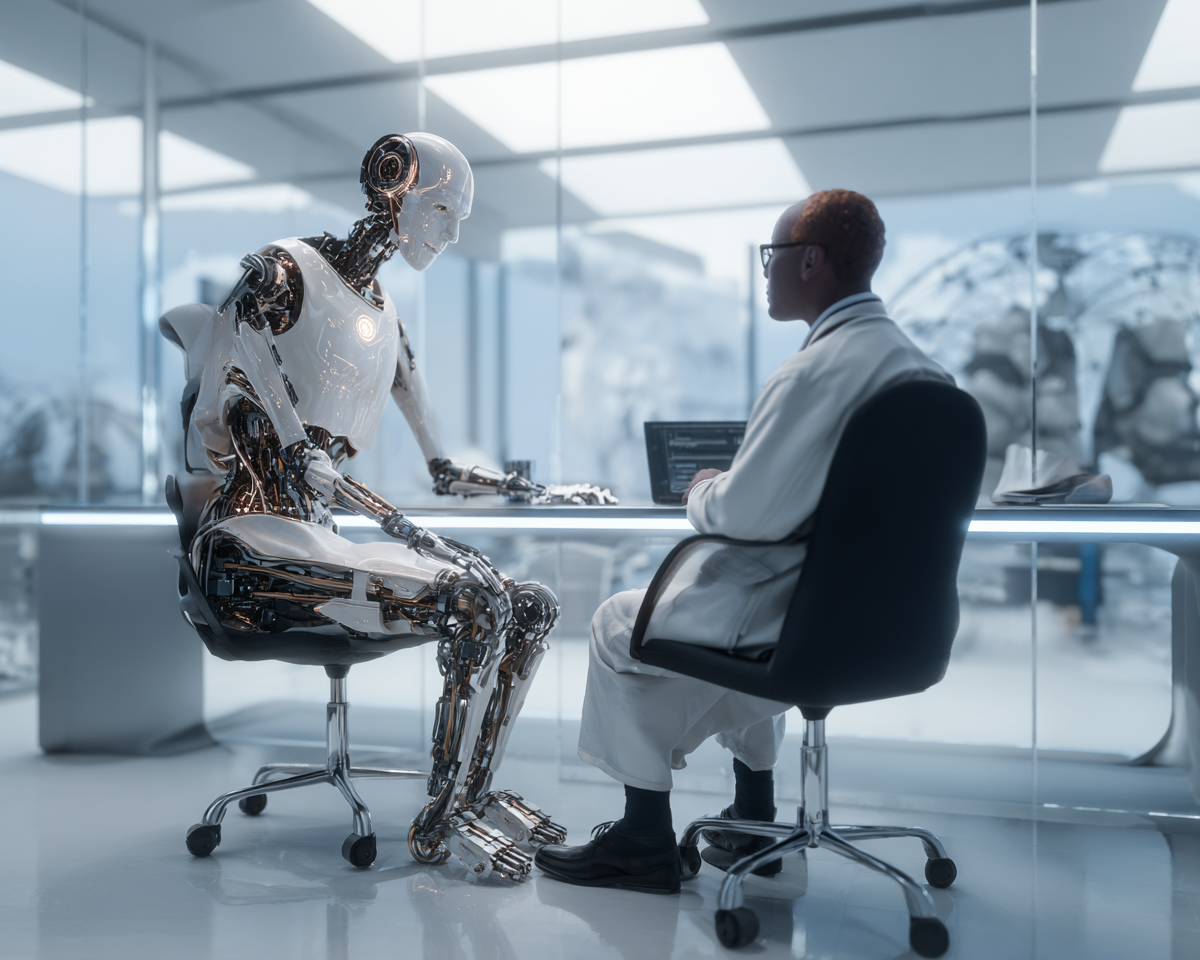
This is the key insight: the future of medicine is not AI replacing doctors, but humans and AI collaborating where each is strongest. Where data is abundant — like distinguishing vertigo from low blood pressure, reported thousands of times — AI can serve patients directly. Where data is rare and stakes are absolute, the surgeon’s hands on the robot’s controls remain irreplaceable.
What This Means for You
Be an informed participant: AI tools can help you understand symptoms, prepare better questions for your doctor, and make sense of test results. Use them as a starting point, not a final verdict.
Expect faster breakthroughs: AI-driven discovery is accelerating drug development, genomics, and our understanding of diseases from cancer to Alzheimer’s.
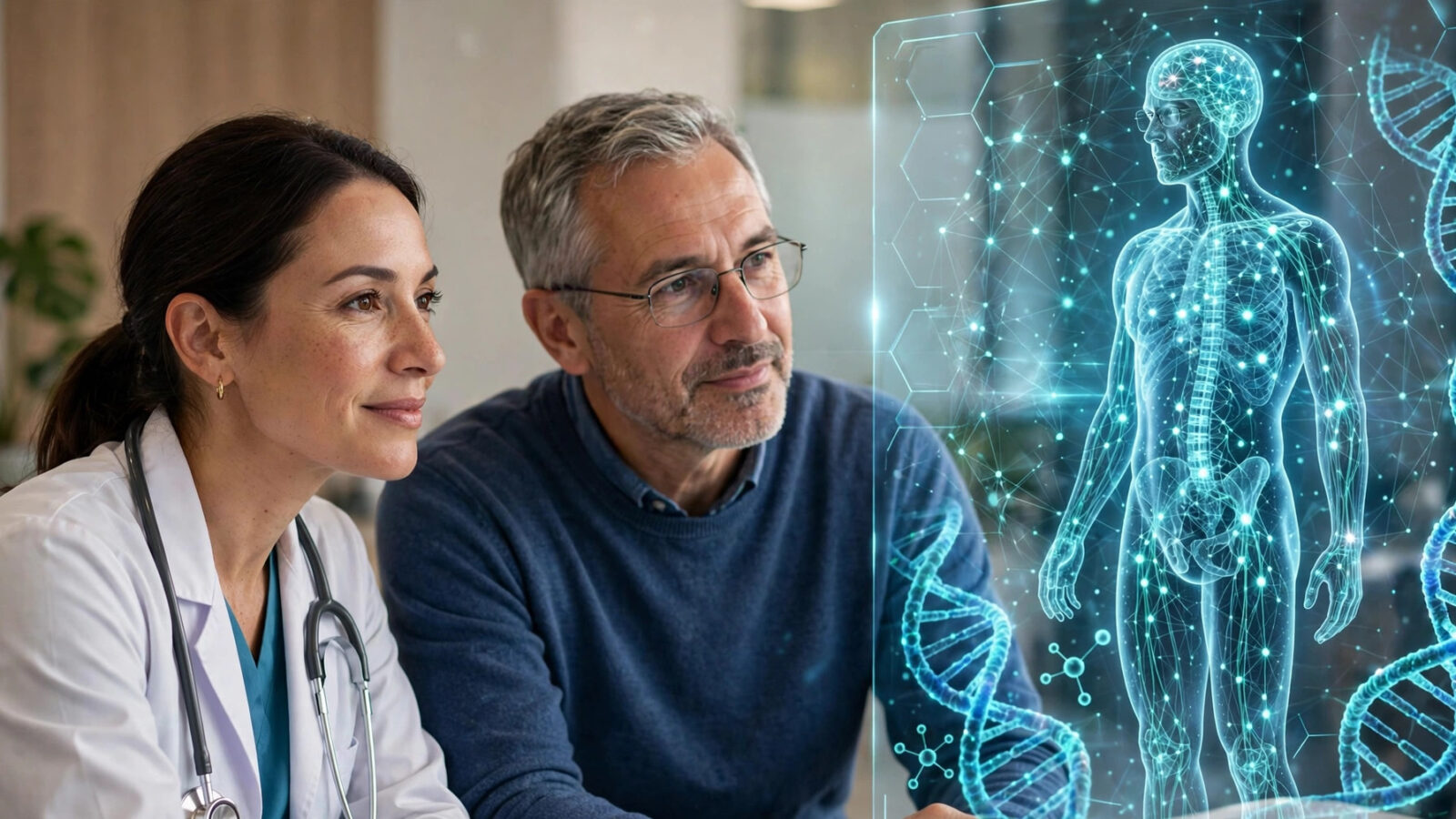
Look for the collaboration: The best care will increasingly come from doctors augmented by AI — robotic-assisted surgery, AI-flagged imaging, and personalized treatment plans drawn from vast datasets.
Stay curious but critical: AI is only as good as its training data. Ask how a tool was validated, and always loop in a qualified clinician for anything that affects your treatment.
“The AI doctor is in — and it is here to work with your doctor, not instead of them.”
The conversation between Dr. Li and Dr. Huberman makes one thing clear: we are living through a moment as transformative as the arrival of electricity. AI will not just make healthcare faster — it will help us understand our own biology at a depth previous generations could only dream of.
Disclaimer: This article is for informational purposes only and is not medical advice. Always consult a qualified healthcare professional about any health concerns.