Last week this site ran a study that surprised a lot of readers: in 13,423 adults aged 65 and older, balance and agility were the fitness qualities most strongly linked with survival over seven years — ahead of cardio, ahead of strength. The living-room tests — a one-leg stand, an eight-foot up-and-go, a 30-second chair stand — became the most-shared piece Health Captain has run in a while.
Here’s the part of that study worth a second look. Balance ranked first. But lower-body strength — the chair stands — ranked second. And the big number in the study, the 61% lower risk of dying in the fittest group, belonged to the combined score: cardio plus strength plus balance and agility together. The people who did best weren’t the best at one thing. They were good at several things at once.
Balance was the start. Muscle is the multiplier.
Why muscle, why now
Muscle after 50 is not about looking athletic. It’s about the ordinary things the study’s tests were already measuring: getting out of a chair without using your hands, catching yourself when you trip, carrying groceries up the stairs, getting up off the floor. Those are strength jobs, and they get harder quietly — a little less power every year, until one day a curb feels high and a suitcase feels heavy.
Strength is also what makes balance trainable. A one-leg stand is partly a nerve-and-ear skill, but holding yourself upright on one leg takes leg strength too. When the legs are stronger, the wobble is smaller, the recovery is faster, and the practice itself gets easier. Train balance alone and you improve balance. Train balance and strength and each one feeds the other.
That’s the logic of the minimum dose: the smallest plan that actually moves the needle, done consistently, beats the ambitious plan that lasts two weeks.
The minimum-dose plan
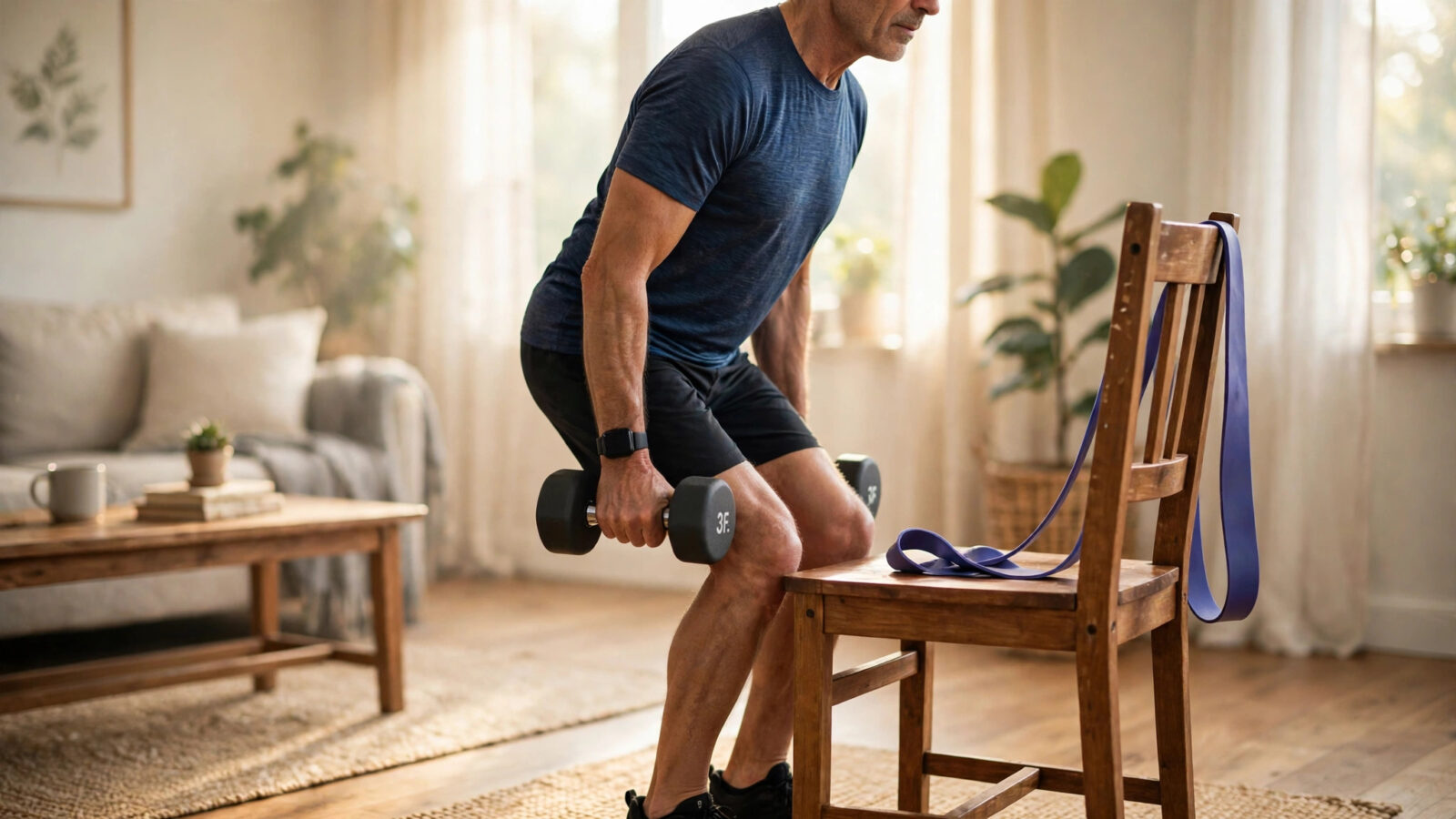
Two or three short strength sessions a week. That’s the whole commitment. Not five days, not an hour at a time — two or three sessions, built around eight core movements that cover the whole body: the push, the pull, the squat, the hinge, and the carry, plus the smaller moves that keep shoulders and hips honest. You don’t need a gym. A pair of dumbbells, a sturdy chair, and a resistance band cover it.
A session has a simple shape:
- Warm up for five minutes. Walk around the house, march in place, roll your shoulders. The point is warm joints, not a workout before the workout.
- Work the eight movements, one set each to start. Slow and controlled beats fast and sloppy — two seconds up, two seconds down, breathing normally, never holding your breath.
- Finish with two minutes of balance. A one-leg stand, thirty seconds a side, hand hovering near the counter. It costs nothing and it closes the loop with the balance work from last week’s piece.
Start with a two-day week. When two days feels routine — usually after about four weeks — add a third day. The progression is the plan: same movements, slightly more weight or slightly more repetitions over twelve weeks, in small steps you can actually feel. If a movement hurts in a sharp, joint-y way, stop it and swap it — pain is information, not a badge.
The six levels of balance
Balance drills work best as a ladder, not a single test. Start where you are and climb one rung at a time:
- Feet together, eyes open, hand near a counter.
- Feet together, eyes closed, hand near a counter.
- One foot in front of the other, heel to toe, like walking a tightrope.
- One-leg stand, thirty seconds a side.
- One-leg stand with a small head turn or an arm reach.
- One-leg stand while doing something else — brushing your teeth, waiting for the kettle.
Stay on a level until it feels steady, not perfect. A wobble is the training working. A fall is not — always have a wall, counter, or sturdy chair within reach, and if you already feel unsteady or have a history of falls, do these with someone else in the room.
The other two ingredients: bone and protein
Muscle doesn’t work alone. Bone is the other half of the strength equation: the same sessions that load your muscles also load your bones, and that’s the point — bone responds to the load you put through it. The book this article is built on covers bone health in plain words, including what helps and what to watch for, and it pairs the training with a home safety audit — a room-by-room check for the loose rugs, dark hallways, and missing handrails that turn a small wobble into a fall.
And then there’s protein. Strength training tells your muscles to grow; protein gives them the material. Most people over 50 eat less protein than they think, and they eat it unevenly — a little at breakfast, a lot at dinner. Spreading it across the day, with a solid portion at each meal, is the simple fix, and a one-week protein tracker is enough to see where you actually stand. No supplements required, no special foods — ordinary meals, counted once, then adjusted.
A sample week
Here’s what a two-day week looks like in practice — the shape, not a prescription:
- Monday — strength session (about 30 minutes). Warm up, the eight movements, two minutes of balance. Write down the weights and reps.
- Wednesday — a walk, plus balance practice. Ten minutes of heel-to-toe walking along a wall, single-leg stands while you wait for things.
- Friday — strength session (about 30 minutes). Same movements as Monday. If Monday felt easy, add one repetition to two of the movements.
- Daily — protein at each meal, and one balance drill while you brush your teeth or wait for the kettle.
After four weeks, add the third strength day. After twelve, look back at the log — the numbers you wrote down are the progress report, and they’re more honest than memory.
What this doesn’t prove
Same honesty as last week’s piece: the study was observational. It measured fitness once and watched what happened over seven years. It can show a link between strength and survival; it cannot show that doing chair stands will extend your life. The people who scored well may have been healthier in ways the tests didn’t capture.
So treat strength the way the study treats balance: as a signal worth paying attention to, and a capacity worth keeping. Stronger legs make the stairs easier next month whether or not they change anything seven years out. That’s reason enough.
If you feel unsteady, have fallen before, or have a condition that affects balance or strength, talk to your doctor or a physical therapist before starting. Bring them your numbers — the one-leg stand time, the chair-stand count, the weights you’re using. That’s what they’re for.
The takeaway
Balance told you where you stand. Muscle decides how far you can go from there. Two or three short sessions a week, eight movements, a little balance every day, protein spread across your meals, and a home set up so a wobble stays a wobble.
Start with the three living-room tests from last week. Write the numbers down. Then add the strength — one session, this week, and see how Monday feels.
This article is educational, not medical advice. Talk with your doctor before beginning a new exercise program.
Want the full program? Strong After 50: Muscle, Bone & Balance is the companion guide to this article — 80 pages from Health Captain: the minimum-dose strength plan with the 8 core movements, 2-day and 3-day weekly templates, a 4-week starter plan and a 12-week progression, balance drills in 6 levels, a room-by-room home safety audit, bone health in plain words, the protein guide with a sample day of eating, session and protein trackers, doctor-visit prep, and a 30-day strength & balance journal. Fillable + light-ink print editions in one purchase. $29.
- Gumroad: https://massdensity.gumroad.com/l/zeceps
- PayHip: https://payhip.com/b/XNjlv
Also from Health Captain: Play Longer: The Tennis Longevity Playbook ($39) — https://massdensity.gumroad.com/l/tennis-longevity — for players who want to stay on court for decades.