The AI Doctor Is Coming: How Artificial Intelligence Will Revolutionize Healthcare
The Next Great Medical Revolution Has Already Begun
For centuries, healthcare has relied on a simple model: people become sick, develop symptoms, visit a doctor, receive a diagnosis, and hopefully receive effective treatment. While modern medicine has dramatically increased life expectancy and reduced suffering, the system remains largely reactive rather than proactive.
Artificial Intelligence is about to change that.
We are entering an era where healthcare may become predictive, personalized, and continuously monitored. Instead of waiting for disease to appear, AI systems could identify warning signs months or even years before symptoms develop. Rather than relying on occasional doctor visits, intelligent health assistants may monitor our bodies 24 hours a day, helping us optimize health, prevent disease, and potentially extend lifespan.
Many experts believe AI will become one of the most transformative technologies in medical history, rivaling the discovery of antibiotics, vaccines, and medical imaging.
The AI doctor is coming—and it may fundamentally change what it means to be healthy.
The Healthcare System Is Under Pressure
Healthcare systems around the world face enormous challenges:
- Physician shortages
- Rising healthcare costs
- Aging populations
- Increased chronic disease
- Administrative burdens
- Limited access in rural regions
Doctors are often overwhelmed with paperwork, insurance requirements, and patient loads that leave limited time for meaningful interactions.
At the same time, patients increasingly want personalized care, rapid answers, and access to information.
Artificial intelligence offers a potential solution by augmenting human physicians and automating many routine tasks.
Instead of replacing doctors entirely, AI could become a powerful co-pilot that improves efficiency, accuracy, and patient outcomes.
What Exactly Is an AI Doctor?
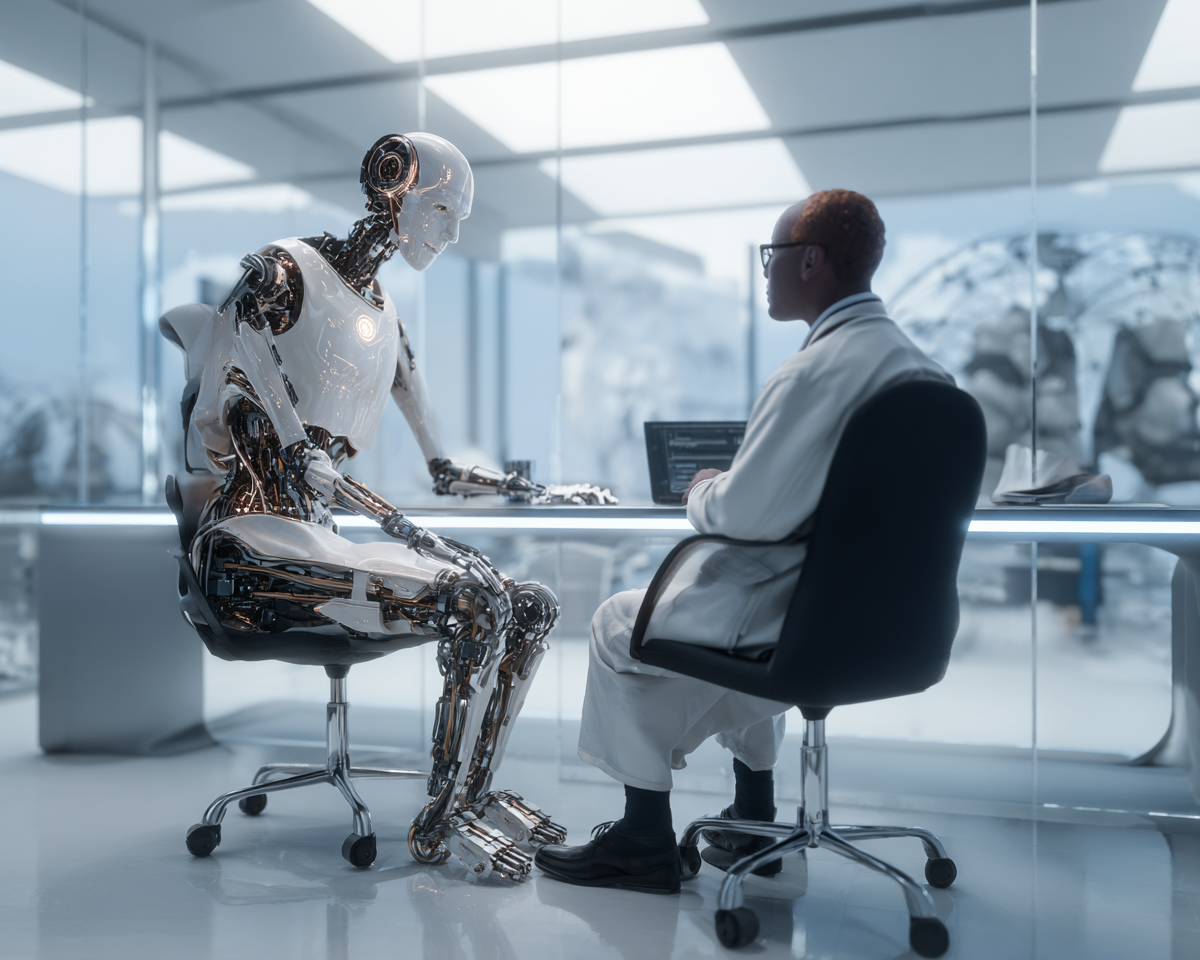
An AI doctor is not a robot wearing a white coat.
Instead, it is a collection of advanced machine learning systems capable of:
- Analyzing symptoms
- Reviewing medical records
- Interpreting imaging scans
- Monitoring wearable device data
- Predicting health risks
- Recommending treatments
- Tracking medication adherence
- Answering patient questions
Unlike human physicians who see patients periodically, AI systems can potentially monitor health continuously.
Imagine having a medical expert available every minute of every day.
That is the future many healthcare innovators envision.
AI Doctors vs Human Doctors
One of the most common questions is whether AI will eventually replace physicians.
The answer is more nuanced than many people realize.
What AI Does Better
Artificial intelligence excels at:
Processing Massive Data Sets
AI can analyze millions of patient records in seconds.
A physician may have experience with thousands of patients throughout a career.
AI can learn from millions.
Pattern Recognition
Machine learning systems excel at identifying subtle patterns that humans may overlook.
This is particularly valuable in:
- Radiology
- Dermatology
- Pathology
- Cardiology
- Ophthalmology
Continuous Monitoring
Humans cannot watch your health 24/7.
AI can.
Future systems may monitor:
- Heart rate
- Sleep quality
- Blood glucose
- Blood pressure
- Oxygen levels
- Activity patterns
- Stress markers
continuously through wearable devices.
Instant Access to Medical Knowledge
Medical information doubles rapidly.
AI can instantly access and analyze enormous medical databases, journals, and treatment guidelines.
What Human Doctors Do Better
Humans remain essential for many reasons.
Empathy
Patients need emotional support.
Compassion, reassurance, and trust are critical components of healing.
AI can simulate empathy, but genuine human connection remains irreplaceable.
Complex Judgment
Medicine often involves ambiguity.
Doctors must consider:
- Lifestyle factors
- Family circumstances
- Emotional health
- Patient preferences
- Ethical considerations
These areas still require human wisdom.
Building Relationships
Long-term physician-patient relationships help improve compliance, trust, and outcomes.
Healthcare is ultimately about people, not just data.
The Most Likely Future: Human + AI
The future is unlikely to be AI versus doctors.
It will be AI plus doctors.
The most successful healthcare model may combine:
- Human empathy
- Human judgment
- AI intelligence
- AI monitoring
- AI prediction
Doctors who embrace AI may become dramatically more effective.
Those who ignore it may find themselves at a disadvantage.
Can AI Predict Disease Before It Happens?
This may be the most exciting possibility of all.
Modern healthcare typically waits until symptoms appear.
AI aims to identify disease much earlier.
Early Cancer Detection
Researchers are developing AI systems capable of detecting cancer signals in blood tests long before symptoms emerge.
These technologies could potentially identify:
- Lung cancer
- Breast cancer
- Colon cancer
- Pancreatic cancer
- Prostate cancer
during their earliest stages.
Earlier detection dramatically improves survival rates.
Heart Disease Prediction
Heart disease remains the leading cause of death worldwide.
AI systems can already analyze:
- Blood pressure
- Cholesterol
- Heart rate variability
- Imaging scans
- Lifestyle patterns
to identify elevated cardiovascular risk.
Future systems may predict heart attacks years before they occur.
Diabetes Prediction
Continuous glucose monitors and wearable devices are generating unprecedented metabolic data.
AI can detect patterns indicating:
- Insulin resistance
- Prediabetes
- Metabolic dysfunction
long before traditional testing methods identify a problem.
Cognitive Decline and Dementia
Researchers are exploring AI models capable of identifying subtle signs of:
- Alzheimer’s disease
- Cognitive decline
- Neurodegenerative disorders
through speech analysis, behavioral changes, and biometric data.
The earlier these conditions are detected, the more effective interventions may become.
Your Personal Health AI Assistant
In the future, nearly everyone may have a dedicated AI health companion.
Imagine waking up and receiving insights such as:
- Sleep quality score
- Recovery status
- Stress level analysis
- Blood sugar trends
- Cardiovascular risk updates
- Nutrition recommendations
- Exercise guidance
Your AI assistant may know your body better than anyone else.
It may recognize subtle deviations before you notice symptoms.
Instead of annual checkups, health optimization could become continuous.
The Rise of Wearables and Real-Time Health Data
Wearable technology is rapidly expanding.
Devices already track:
- Heart rate
- Sleep
- Activity
- Oxygen saturation
- Body temperature
Emerging devices may soon monitor:
- Glucose
- Hydration
- Hormones
- Blood pressure
- Stress biomarkers
AI will transform these streams of data into actionable insights.
The combination of wearables and AI could become one of the most powerful health technologies ever developed.
The Longevity Revolution
AI is not only about treating disease.
It may help us slow aging itself.
Researchers are increasingly using artificial intelligence to:
- Discover new drugs
- Analyze aging biomarkers
- Develop longevity therapies
- Identify optimal lifestyle interventions
AI could dramatically accelerate discoveries in:
- Epigenetics
- Stem cells
- Regenerative medicine
- Senolytics
- Gene therapies
Some scientists believe these advances may significantly extend healthy lifespan during the coming decades.
Risks and Challenges
Despite its promise, AI healthcare raises important concerns.
Privacy
Health data is highly sensitive.
Strong protections must be established to safeguard patient information.
Bias
AI systems are only as good as the data used to train them.
Poor data can lead to inaccurate recommendations.
Over-Reliance
Patients should not blindly trust AI outputs.
Human oversight remains essential.
Regulation
Healthcare decisions affect lives.
Careful oversight is needed to ensure safety and accuracy.
The Future of Medicine
The future of healthcare may look very different from today.
Instead of reacting to illness, medicine may focus on prevention.
Instead of occasional doctor visits, health monitoring may become continuous.
Instead of generalized recommendations, treatments may become deeply personalized.
Artificial intelligence is poised to become one of the most powerful tools ever introduced into medicine.
The winners of the next healthcare revolution may not simply be those who live longer, but those who use technology to live healthier, stronger, more vibrant lives.
The AI doctor is not a distant science-fiction fantasy.
It is already beginning to arrive.
And over the coming decade, it may transform healthcare more profoundly than any innovation in modern history.
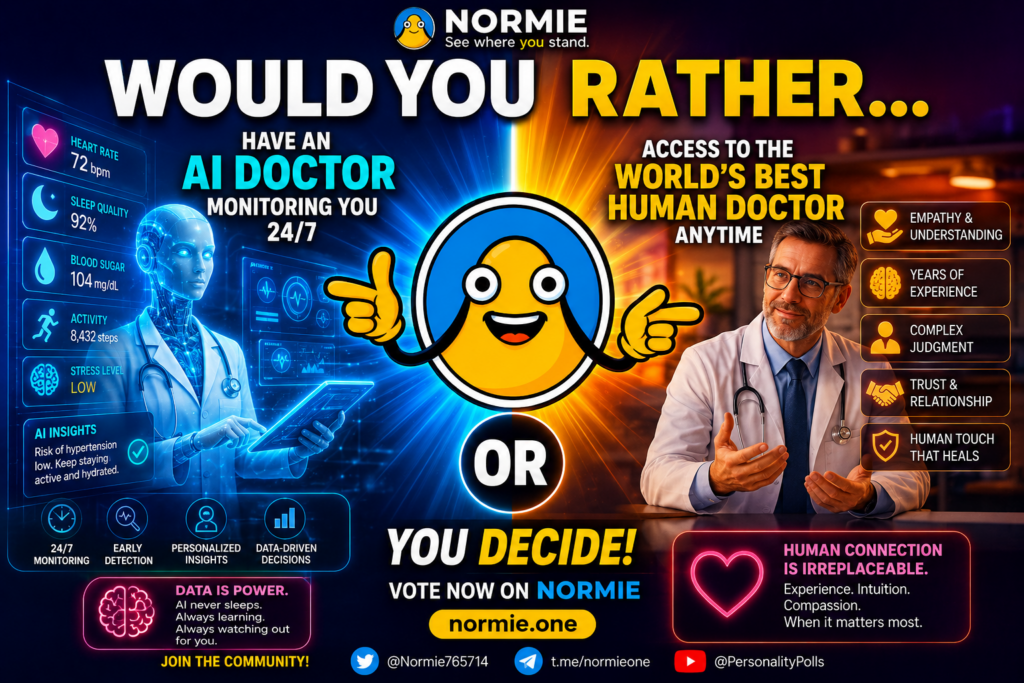
Would You Rather…
🤖 Have an AI Doctor Monitoring You 24/7…
OR
👨⚕️ Access to the World’s Best Human Doctor Anytime?
An AI doctor could continuously monitor your sleep, heart rate, blood pressure, blood sugar, activity levels, and health data—potentially detecting disease before symptoms even appear.
A world-class human doctor brings experience, intuition, empathy, and the ability to navigate complex medical decisions that no machine fully understands.
Which future would you trust with your health?
Vote now and see how your answer compares to everyone else on Normie!
🌐 https://normie.one/
𝕏 https://x.com/normie765714
📺 https://www.youtube.com/@PersonalityPolls
📱 https://t.me/normieone
#WouldYouRather #Normie #AI #Healthcare #Longevity #FutureOfMedicine #ArtificialIntelligence #HealthTech #Biohacking #DigitalHealth #PreventiveMedicine